
Review: Askar FMA230 Telescope
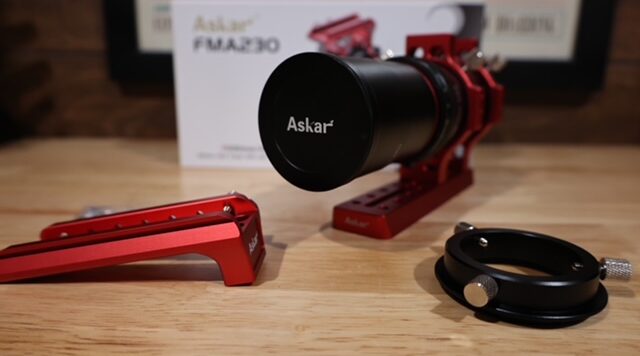
Recently I have been given the opportunity to review the FMA-230 from ASKAR. One of the main reasons I was excited to try out this new astrograph was the ability to use my ZWO 2600MM mono APS-C camera on it and also try my ZWO ASI6200MM as its full frame sensor is pretty amazing. I was really interested how it would perform as one of my many passions is doing wide-field photography.
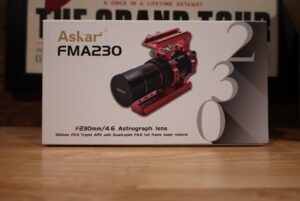
Who are Askar?
So, let’s talk about Askar. Askar is an Optical Instrument Company located in Jiaxing city in China’s Zhejiang province. They offer a wide range of high-quality telescopes and optics. Even though they have not been around for as long as their competitors they have been keeping up with the bigger company brands.
There are a lot of small refractors on the market today that range from Radian, Williams Optics, etc, but what draws people to small wide-field astrophotography is the simplicity of smaller scopes and because they provide the ability to travel anywhere.
The FMA-230 does not disappoint in this area. It would easily fit on any star tracker that’s fast and affordable.
The FMA-230 is a part of the Askar FMA family, and like their other telescopes, it will bring your observing and imaging experience to a whole new level! The FMA-230 is lightweight, compact, it functions as a lens for observing, or as a telescope for direct-focus photography. It has a three-element 50mm ED f/5.5 objective lens that can use 1.25″ and 2″ eyepieces with the included adapters. And has a Helical Focuser. These are just a few of the main features the telescope has.
Initial Impressions
When I received the FMA-230 it was in a well-padded retail box that was packed in a shipping box. After removing it from the box my first impression was that the telescope felt very lightweight and easy to handle.
I placed the FMA-230 on my Explore Scientific IEXOS-100, a lightweight version of the Explore Scientifics PMC-Eight system and has a weight limit of 9lbs / 4 kg when doing astrophotography. The reason I chose to use this mount is because of the lightweight portability that it offers. 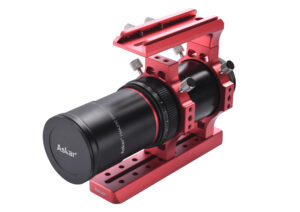
Let’s talk about the features of the FMA-230.
The FMA-230 has a Helical Focuser. A Helical focuser is not as common as they once were. This type of focuser offers a very smooth and backlash-free movement that can work very well to accomplish the fine focusing of a CMOS camera.
A standard Rack and Pinion or Crayford focuser offers a different type of experience in getting a telescope into focus because they use cast (or if you’re lucky, machined) gears. Due to the nature of a gear system on the FMA-230, there is a bit of play between components.
So what does this mean for the everyday user?
Well, let’s say I want to use the ZWO EAF on the Helical Focuser. The FMA-230 does not come with all the hardware you need to install an electronic focuser like the ZWO EAF.
You would need to purchase additional items to install the EAF, like the excellent kits produced from DeepSkyDad .
These belt-driven kits can be controlled by the EAF to control focus or some other means. But once purchased and installed you will be able to begin automated astro imaging.
Setting Up
Once all my equipment was set up I wanted to see how wide this 50mm went so I turned my sights to M31 and The Andromeda’s Galaxy with the reducer. I found that my targets fit in the frame nicely
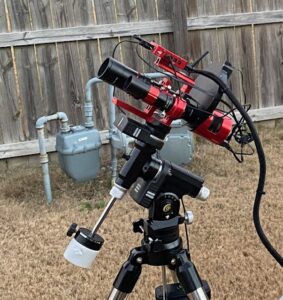
I’m not going to lie, I struggled with the back focus, it was mostly user error. But once I got it fixed I was moving and grooving.
The results of my full-frame image were not the best and I didn’t spend a lot of time on it as I ad limited time with the review item.
I ended up doing an LRGB image and here is how it turned out – I was quite pleased with the first light results.
The acquisition time was a little less than 10 hours of data and with the results, I can’t complain. There is some great color on the combined image.
If I were able to acquire more data I feel I could have an even better image.
Image Quality
I also ran an image analysis on the data as well on a single raw frame. I wanted to analyze true data, especially in the corners to see if 55mm was the correct spacing for the ZWO ASI2600 APS-C sensor.
Here are some samples from a single image showing 9 areas of interest to show the details from the entire field.
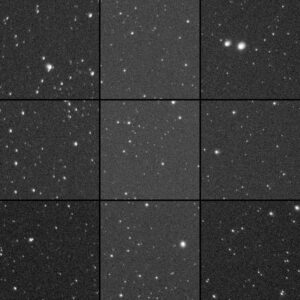
This is an image analysis of the Andromeda Galaxy.
The 9 segments of the analysis show the star shapes achieved across the sensor field.
The focus was a little off but I could tell I was in the ball park with a 55mm spacing.
I would have to adjust focus and maybe add a 1mm spacer but I was there and it looked great other than that.
When it came to using the full frame ASI6200 I really struggled with the corners of the image as they were elongated even at the recommended 55mm of backspacing.
I was unable to resolve it in time of this review as well. That’s not to say the lens was an issue but I ran out of time to get more conclusive results.
Conclusion
This telescope is great and affordable for Astronomers that are getting into the hobby and want to look into purchasing their first scope for astrophotography. It offers a lightweight, go-anywhere approach, a big bang for your buck intro to the hobby.
The only suggestion I have for the product is that Askar would look into replacing the thumbscrews with nylon-tipped screws. When I received the FMA-230 for review there were scratches on the telescope because the thumb screws were not nylon tipped, which in shipping caused the scope to shift and scratch the tube on the astrograph.
The Helical Focuser on the FMA-230 can also be tight and difficult to get used to. The additional downside of the focuser is that you would have to order more parts to set it up to be fully automated on focusing. Which in my opinion is kind of a bummer, especially if you’re just getting into the hobby or if you are coming from another telescope that has a standard Rack and Pinion or Crayford style focuser.
Since the telescope is extremely budget-friendly I did not personally see this as a downside. In fact, I would recommend when purchasing the extra parts needed you also get the Askar Multi connection plate so that you can attach a guide scope anywhere to the cradle rings.

So why would you go with Askar?
In my opinion, it would be because they provide a lightweight, easy travel, budget-friendly telescope that is comparable to any other smaller refractor that is a triplet and comes with a corrected reducer.
I highly recommend Askar products and I can’t wait to see what they come up with next.
Further Information
